OCEB2F - Full Printable Slides
Copyright Notice
Copyright © 2004-2026 by NobleProg Limited All rights reserved.
This publication is protected by copyright, and permission must be obtained from the publisher prior to any prohibited reproduction, storage in a retrieval system, or transmission in any form or by any means, electronic, mechanical, photocopying, recording, or likewise.
Table of contents⌘
| Module 0. Introduction | 3 |
| Module 1. Business Goals, Objectives | 14 |
| Module 2. Business Process Concepts and Fundamentals | 45 |
| Module 3. Business Process Management Concepts and Fundamentals | 87 |
| Module 4. Business Motivation Modeling | 119 |
| Module 5. Business Process Modeling Concepts | 181 |
| Module 6. Business Process Modeling Skills | 228 |
| Module 7. Process Quality, Governance, and Metrics Frameworks | 268 |
Module 0. Introduction⌘
Object Management Group⌘

The Object Management Group (OMG) is an international, open membership, not-for-profit computer industry standards consortium.
The most important OMG standards:
- UML (Unified Modeling Language)
- BPMN (Business Process Model and Notation)
- SysML (Systems Modeling Language)
OMG Certified Expert in BPM 2 (OCEB2)⌘

- Certification program based on BPM
- The OCEB 2 examinations cover much more than BPMN
- To obtain a higher certificate you have to pass the lower test level
OMG Content Developer⌘

NobleProg has official OMG OCEB 2 and OCUP 2 Content Developer status, which means that our course outlines and training materials were developed by the same experts who prepared questions for both certifications.
Two people from NobleProg team take an active part in the work of OMG, which deals with determining the subjects of OCEB 2 and OCUP 2 examinations and creating test questions.
What is BPM?⌘

Business Process Management (BPM) is a discipline involving any combination of modeling, automation, execution, control, measurement and optimization of business activity flows, in support of enterprise goals, spanning systems, employees, customers and partners within and beyond the enterprise boundaries.
The Workflow Management Coalition, http://wfmc.org/what-is-bpm
OCEB 2 Tracks and Levels⌘

- Above the Fundamental level, the OCEB2 program splits into a Business Track and a Technical Track with an Intermediate and Advanced level in each.
OCEB 2 Fundamental⌘
- Covers basic elements of Business Essentials and Business Modeling, Business Process, Business Process Management, Business Process Modeling, and essential and widely-used industry frameworks.
| Examination Number: | OMG-OCEB2-FUND100 |
| Duration: | 90 minutes for residents of English-speaking countries; 120 minutes for all others |
| Number of Questions: | 90 |
| Minimum Passing Score: | 62 correct responses |
| Exam Fee: | US $210 (or equivalent in local currency) |
| Prerequisite: | None |
OCEB2 Fundamental - Coverage Table⌘
| 1 | Business Goals, Objectives Business fundamentals, strategy, planning and goal-setting, project management, marketing, staffing, finance. | 8% |
| 2 | Business Process Concepts and Fundamentals Discovering business processes, As-Is vs. To-Be process | 11% |
| 3 | Business Process Management Concepts and Fundamentals Functional vs. Process-Centric Enterprise Organization | 10% |
| 4 | Business Motivation Modeling Business Vision, Goals, Objectives; Means and Ends; Mission, Strategies, Tactics; | 16% |
| 5 | Business Process Modeling Concepts - BPMN 2.0 | 24% |
| 6 | Business Process Modeling Skills - BPMN 2.0 | 16% |
| 7 | Process Quality, Governance, and Metrics Frameworks APQC, SCOR, BPMM, Six Sigma, COBIT, Basel 2, ... | 15% |
OCEB 2 Fundamental - Reference List⌘
http://www.omg.org/oceb-2/coveragemap-fund.htm
OMG Certified Professionals Directory⌘

http://www.omg.org/cgi-bin/searchcert.cgi
Pearson VUE⌘

- The OCEB2 examinations are offered worldwide in English at Pearson VUE testing centers.
- You need to show two valid forms of personal ID, both must have your signature, and one of the two must have your photo.
- The test room is monitored electronically by video, or personally by a test assistant.
- At the end of the test, the candidates can see their results on their screens.
- Candidates will be given a printout of their test results by the test center.
- Successful candidates will receive a colored official certificate by mail several weeks later.
Module 1. Business Goals, Objectives⌘
Business Basics from the purely Business Point of View
- Business fundamentals
- Strategy
- Planning and goal-setting
- Project management
- Marketing
- Staffing
- Finance
Source of information⌘
 | Steven Stralser, MBA in a Day, Wiley, 2004 [ ISBN-10: 0471680540 ] |
| Error creating thumbnail: File missing | Tim Gorman, The Complete Idiot's Guide to MBA Basics, 2nd Edition, Alpha, 2003 [ ISBN-10: 0028644492 ] |
Project Management⌘
- PMI definition: "The application of knowledge, skills, tools and techniques to a broad range of activities to reach a predetermined goal or objective."
- Usually organizations manage project portfolios
Project Management as a Process⌘
- PM is made of IPECC:
- Initiation - project is started, a project manager is selected.
- Planning - plan how the project should go.
- Executing - project team completes the work.
- Controlling - control the work to ensure that’s it done according to plan.
- Closing - project work is complete, close out the project finances, team reports.
- According to the PMI, one of these steps fails in 74% of projects
- IPECC are activities of BPs
Sample Questions⌘
According to PM Institute, what might cause a project failure?
- One of the process steps: financing, risk appraisal, goals, monthly progress reports.
- One of the process steps: purposes, finances, actions, prioritizing.
- One of the process steps: delineation, time frames, venue creation, promotion activities.
- One of the process steps: initiation, planning, executing, controlling, closing.
Sample Question⌘
According to the Project Management Institute, Project Management covers what areas?
- A variable sequence of specialized activities including: reporting a sequence of activities, designing the proper retreats for the managers, and supporting roles.
- A fixed sequence of standard activities including: scheduling a sequence of activities, designing, effectively managing business and supporting modern systems and processes.
- A range of topics covering management of development process to ensure its efficiency, effectiveness and success.
- A wide range of topics, designed to reach an objective or goal, including the application of knowledge, skills, tools and techniques.
Marketing⌘
- Is a Strategy and a Process
- Marketing are activities you do in order to sell a product or provide a service
- Influences how customers perceive a business and generates interest and encourages customer to pay for the product or services
Marketing Strategy and Practice⌘
- Marketing is actually the process by which we offer goods or services up for sale
- Marketing is not a cost or expense but rather a strategic investment
- Benefit of marketing is longer-term
- Social and managerial process by which individuals or groups obtain what they need and want through creating, offering and exchanging products of value with others
- The foundation and catalyst of making sales is marketing
- The key to successful sales is a consistent proactive marketing strategy
Key to consistent proactive
marketing strategy⌘
(from MBA in a Day)
- Dedicate their resources to ensuring that the wants, needs and demands of the customer are the firm's focus
- Customer focus is the foundation of the strategy of the marketing process
- Plan that gives direction, guidance, and a structure of proactive strategies to increase sales and improve business relationships
Marketing Four P's⌘
- Marketing Mix is represented by the well-known "4 P's of Marketing"

Marketing as Business Process⌘
- An effecting marketing strategy/plan is an value-creating process composed of several elements:
- Market segmentation
- Marketing strategy
- Market research
- Pricing
- Placement
- Value chain
Market Segmentation⌘
- Marketing strategy that involves dividing a broad target market into subsets of consumers who have common needs and priorities, and then designing and implementing strategies to target them.
- Market segmentation is simply taking a look at the overall market of your product and service and thinking of it in terms of smaller, more manageable pieces
- Market segmentation strategies:
- geographic segmentation (regional or local markets)
- demographic segmentation (age, gender, income, race)
- product segmentation (cars: luxury, midsize, compact, sport, ...)
- sales-channel segmentation
- Example:
- Market for a hotel rooms.
- Rolls-Royce targets wealthy individuals with disposable income > 500k a year
- Who would be a segment for Barbie Doll?
Marketing strategy⌘
Marketing strategy is like a plan that directs business activities of a company to achieve predefined goals
Market research⌘
- All activities that help to get and analyze information on customers (attitudes, behaviors, ...) that affect buying your product.
- Market research means trying to understand your customers.
- Some important types of information:
- Buying behaviors (the way in which customers buy)
- Customer feedback / satisfaction
- Lifestyle and attitudes
Pricing⌘
Some examples of pricing strategies:
- cost-plus pricing
- competitive pricing
- value pricing
Placement⌘
There are many ways of selling:
- direct sale
- wholesale / retailer
- telemarketing
- Internet
- ...
Marketing and the Value Chain⌘
- The focus on strategy is to build value for the company, so strategy often involves value chains
- A value chain is process of producing and delivering product or service (all activities that add value to the product in any way)
- A value chain typically includes
- Inbound and outbound logistics
- Marketing and Sales
- Services
- Firm's Infrastructure
- HR
- Technology
Human Resources⌘
- A critical process area
- HR helps managers hire, orient, train employees, creates guidelines for employee compensation and performance evaluations.
- Recruitment process is responsible for filling open positions in the company.
- Compensation is defining job functions and qualifications, defining salary ranges
Human Resources⌘
Signs of a poor Onboarding and related processes include:
- Regular breakdowns in flow
- Missed deadlines
- Increased returns
- Decreased customer loyalty
- Regular administration mistakes
- Frequent absenteeism and turnover caused by:
- Overstressed employees
- Poor morale
- Looking for other employment
- Excessive overtime caused by employees being overworked or given too much responsibility
- Overworked employees can lead to burnouts and increase costs in the long run
Strategy⌘

- Strategy is a process that transfers a long term vision into day-to-day tactics.
- Strategy involves all areas of the company from operations to finance to HR.
- Processes should be connected to a business model (BMM)
- Michael Porter created standard for strategy and analysis
- Porter's Five Forces process
- Analyse the industry and company's environment
- Paints a picture of the current environment
- Develop long-term strategies
Porter's Five Forces⌘
- Five Forces is a framework for industry analysis and business strategy development.
- This model can be used on any firm of any size in any location in any industry and can be utilized regularly to keep a constant eye on the market, the direction of the market, and the competitors coming and going within that market.
Porter's Five Forces Analysis⌘

The outcome of the Porter's Strategic Process should be a strategic plan with objectives with dates and quantities
Porter's Five Forces Examples⌘
- Threat of new entrants: "The barriers to entry in the telecommunications market are extremely high"
- Threat of substitute products: substitute of traditional phone with VoIP phone, tap water as a substitute for Coke
- Bargaining power of customers: Large store can purchase in large volume from the supplier, forcing down prices for the end customer.
- Bargaining power of suppliers: If you are making biscuits and there is only one person who sells flour, you have no alternative but to buy it from them.
- Intensity of competitive rivalry: all four aforesaid create rivalry among competitors.
Managers Must⌘
- Monitor the Essential Six business principles
- Value for customers - a business exists to create value of some kind (increase value of raw materials or activities)
- Organization - an organization must have goals and the resources (human, material, financial)
- Competitive advantage - a company must do something better than other companies in that business
- Control - ensure that the manager knows what's going on
- Profitability - a business has to make money
- Ethical practices - hold themselves to the highest ethical standards
Management Types: process Participants⌘
- Finance: make certain there is enough money for the company to operate
- Accounting: counts the money
- Operations: makes what the company sells
- Marketing: sells
- Sales bring the money
- Support functions do the rest (HR, Legal, Investor Relations, Facilities)
Accounting Basics⌘
- Asset - is an economic resource, everything the company owns: the furniture, the inventory, the equipment, the building, and even cash in the bank, value of ownership that can be converted into cash
- Assets are there to generate cash.
- Liability - amount of money owned by the company to an organization or individual (suppliers, creditors, government - taxes). It must be paid on specific date.
- Liabilities arise from past transactions or events.
- Owners' equity - the amount left for the company's owner
- Assets - Liabilities = Owner's equity
- Balance sheet - a picture of the company's accounts at a certain date
Accounting Basics⌘

Finance, Metrics and Balance Sheet⌘
- Finance and Accounts are deeply involved in the mysteries of the balance sheet
- Of all controls the balance sheet is the most important
- Financial Metrics include
- Working capital measures a company's capability to pay its current obligations (Current Assets − Current Liabilities)
- Current Ratio also called the working capital ratio, shows the relationship between current assets and liabilities
- The quick ratio (AKA acid-test or liquid ratio) is the capability of the company to meet its current obligations with most liquid assets


Management Analysis⌘
In addition to monitoring the financial health of the company, managers engineer the results of the strategy.
- Break-even point (BEP) is the point at which cost or expenses and revenue are equal: the operations has not made a profit or a loss

- Return on Investment (ROI) or sometimes just return is the ratio of money gained or lost of an investment relative to the amount of money invested
- ROI = (Net profit / Investment) × 100%
Cost Accounting ⌘
- Process of tracking, recording and analyzing costs associated with the products or activities of an organization.
- fixed costs: remain the same regardless of the amount of product the company makes or sells
- variable costs: change with company's production and sales volume
- Prototypical factors include
- Raw Materials
- Labor
- Indirect Expenses
- Overhead (electricity, water, rent, ...)
Module 1. Questions⌘
- How can marketing process be described?
- What does HR do?
- What is Porter's Five Forces Analysis?
- What is Value Chain?
- What is BEP and RIO?
- What is Working Capital?
- What kind of costs are there?
Module 2. Business Process Concepts
and Fundamentals⌘
Source of Information⌘
Laury Verner, The Challenge of Process Discovery, BPTrends, May 2004
Bruce Silver, Three Levels of Process Modeling with BPMN, BPMS Watch, April 2008.
Source of Information⌘
| Error creating thumbnail: File missing | Howard Smith & Peter Fingar, Business Process Management: The Third Wave, Fourth Anniversary Edition, Meghan-Kiffer, 2007 [ ISBN-10: 0929652347 ] |
 | Martyn Ould - Meghan-Kiffer, Business Process Management: A Rigorous Approach, 2005 [ ISBN-10: 0929652274 ] |
 | James F. Chang, Business Process Management Systems: Strategy and Implementation, 2005 [ ISBN-10: 084932310X ] |
Fundamental aspects of Business Processes⌘
- BPM as a management philosophy has been discussed since 1990s.
- Several management principles are associated with BPM. Most of these concepts are identical to BPR and TQM concepts.
- BPM's first principle is: processes are assets that create value for customers (Chang)
- Functions or individuals do not produce value for customers (e.g. sales function).
Process Characteristics⌘
- Characteristics of business processes
- Have customers
- Properly designed processes reflect how a business executes its business
- Core processes and processes that generate the most value to customers should be managed and continuously improved
- Management of a process involve measuring, monitoring, controlling and analyzing.
- IT is an essential enabler - provides real-time processing information that is important to monitor and control business processes.
- Processes have their origin in the industrial engineering discipline. Originally considered to improve manufacturing and logistics functions.
Business Processes⌘
- Part of the focus of Process Analysis arises from complexity
- Organization Complexity
- Condition of having many diverse branches and autonomous but interrelated and interdependent components or parts linked through many interconnections. In the context of an organization, complexity is associated with
- (1) interrelationship of the individuals,
- (2) their effect on the organization, and
- (3) the organization’s interrelationships with its external environment.
- Condition of having many diverse branches and autonomous but interrelated and interdependent components or parts linked through many interconnections. In the context of an organization, complexity is associated with
BP Definition⌘
Fingar and Smith's "Third Wave" BP definition:
- A business process is the complete and dynamically coordinated set of collaborative and transactional activities that deliver value to customers.
Characteristic of Processes⌘
- Large and complex, involving the end-to-end flow of materials, information and business commitments
- Dynamic, responding to demands from customers and to changing market conditions.
- Widely distributed and customized across boundaries within and between business, often spanning multiple applications on disparate technology platforms.
- Long-running – a single instance of a process may run for years
- Automated – at least in part. Routine or mundane activities are performed by computers wherever possible, for the sake of speed and reliability
- Both "business" and "technical" in nature – IT processes are a subject of business processes and provide support to larger processes involving both people and machines. End-to-end business processes depend on distributed computing systems that are both transactional and collaborative
The Third Wave⌘
- Fingar and Smith created a breakthrough in the way information systems are designed and implemented.
- Transforming the processes they automate and replacing the re-engineering revolution
- Pioneering companies are building the agile enterprise
- The goal is to become High Performance Organization (HPO)
Three Waves of BPM⌘
 | Fredrick Taylor's (1920's) theory of management, processes where implicit in work practices and not automated |
 | BPR (1990's) aimed to help organizations fundamentally rethink how they do their work in order to dramatically improve customer service, cut operational costs, and become world-class competitors |
 | BPM (2003) - processes are the fundamental building blocks that have been hidden, now they must be made visible, explicit and transparent to all stakeholders, so they can be improved and optimized |
Third wave processes are:
- First-class citizens in the world of automation
- Managed and controlled
- Change is the goal, the ability to change is far more prized than the ability to create in the first place
Process Centric Organizations⌘
Functional vs Process Centric Focus⌘


Functional vs Process Centric Focus⌘
|
|
Functional Organization |
Process Organization |
|
Work Unit |
Department |
Team |
|
Key Figure |
Functional Executive |
Process Owner |
|
Benefits |
Functional excellence Easier work balancing because workers have similar skills Clear Management direction on how work should be performed
|
Responsive to market requirements Improved communication and collaboration between different functional tasks Performance measurements aligned with process goals
|
Functional vs Process Centric Focus⌘
|
Weaknesses |
Barrier to communication between different functions Poor handover between functions that affects customer service Lack of end-to-end focus to optimize organization performance
|
Duplication of functional expertise Inconsistency of functional performance between processes Increase operational complexity
|
|
Strategic Value |
Supports cost leadership strategy |
Supports differentiation strategy |
Quiz⌘
Select sectors which in your opinion are process oriented and which functional focus?
- Insurance
- Banking
- Public sector
- Manufacturing
- Financial
- Telecommunication
- Cars
Function vs Process Organizations⌘
Organizations with a strong process-focus are different than a functional organization
- Process orientation is used in insurance, financial services and others
- Functional orientation is still present in services, small enterprises and other companies
Identifying (Discovering) business processes⌘
- Why does process discovery presents a challenge?
- A mistaken assumption: companies know how their business processes work.
- Process knowledge is often tacit i.e. 'in the minds of the participants'
- Participants have a local view of the process. No one has an end to end, global view of the process.
- Laury Verner's Definition of Process Discovery is to 'transform the organizational understanding of current business process from tacit or implicit to explicit. An explicit process will communicate the structure and details of business processes in such a way, that everyone can understand them and make appropriate decisions.'
Discovery Roles⌘
- Subject Matter Expert (SME) - the source of information about the process (business manager, worker on the front line, who performs process tasks day after day, an IT professional, especially when the process is heavily automated)
- Sponsor - business executive deciding process scope and the goals. Explains the current business problems, identifies processes that need to be discovered, and establishes the timetable for the overall project.
- Analyst - person with engineering or IT background, responsible for compiling, organizing, analyzing, and presenting the information gathered from the SME’s.
Approaches to Process Discovery⌘
Discovery sessions can be approached in different ways
- Centralized or Distributed
- Top-down or Bottom up
- Free form or Structured
Centralized or Distributed⌘
- Centralized: Analyst assembles multiple Subject Matter Experts (SME's) together for a series of workshop sessions.
- Distributed: Analyst obtains information from SME's in a separate discover sessions. The Analyst captures a series of “process fragments,” which are portions of an entire end-to-end process.
Top-down or bottom up⌘
- Top down: start with large scale processes and divides them into smaller scale processes
- Example: Start with the "Order to Cash" process and decompose it into a series of constituent processes (Manage Customer Contact, Enter Order, Process Order, Bill Customer, and Receive Payment)
- Bottom up: The SME's offer information about their process responsibility, analysts gather this local information and assemble it into a process context.
Free Form or Structured⌘
- Free Form: SME's informally describe the processes, its issues examples, war stories, etc.. After the raw information is captured, the analyst will structure this information into visual diagrams and written document.
- Structured: the SME responses to a pre-defined set of questions, structured and organized to ensure consistency.
Process Discovery Example⌘
In a process discovery project, experts complete a adobe form, built by the analyst, with attributes and question that define of each activity they know. How is this approach classified according to Laury Verner?
Output of Process Discovery⌘
- The purpose of discovery is to provide insight into the underlying business problems that motivated the discovery
- The outcome is the foundation for a diagnosis of the 'As-is' processes and as a basis for the design of the 'To-be' processes
- From the knowledge base generated in discovery we need to create work products
- The two most important types are visualization work products (diagram) and analysis work products (job description, etc..)
More... The Challenge of Process Discovery, Laury Verner
Process Discovery Output⌘
- The Process Space
- Process Topology
- Process Attributes
Process Space⌘

- We do not generally conduct discovery in order to discover a single process
- A high-level value chain like “produce a match” is really a complex network of interrelated processes
- It is important to understand the ways that processes feed one another.
- For example, the order management process feeds data to the billing process
- The discovery requirement is therefore to identify all the relevant processes and to understand their integration points
- One effective way to organize processes is to create a hierarchy
- In this way, higher level processes can be decomposed into lower level processes, in a series of layers
- At the lowest layer of the hierarchy are the activities - individual process steps that are not decomposed
Process Topology⌘

- We first must know the individual process steps or activities
- Second, we need to know the shape of the process i.e. the flow logic: process entry and exit points, sequential flow of activities, decisions, forks and joins.
- This information is essentially visual and we need a visual rendition to understand the topology
Process Attributes⌘
- It is important to understand the detailed attributes of the process and the attributes of each activity in the process
- Without this information, it is impossible to perform simulation or to create analytical reports
Process Attributes⌘
Examples of attributes of the process as a whole:
- Process Owner: Who is the business owner of the process?
- Purpose: What is the ultimate purpose of the process?
- Customer: On whose behalf is the process performed?
- SME: What is our source of information for the discovery?
Process Attributes⌘
Examples of attributes of each activity in the process:
- Roles: Who performs the activity?
- Resources: What tools are used?
- Data: What data structures does the activity consume and produce?
- Duration: What is the touch time and total time of the activity?
- Description: What is done in the activity?
- Rules: What business rules govern the performance of the activity?
- SME: What is our source of information for the discovery?
Levels of BPMN Process Modelling
(Bruce Silver)⌘
- Descriptive modeling
- Abstract, high-level, simple to communicate across the organization
- Requires understanding of fundamental concepts such as pools and lanes, tasks and subprocesses and sequence flow, not the complexities of BPMN's various flow control and event patterns
- Analytical modeling
- More details, showing all the steps, including the exception paths required to analyze process performance using simulation or to create details requirements for an IT implementation. Requires understanding of BPMN's various decisions and merge patterns, event and exception handling patterns. Hierarchical representation of the end to end business process
Levels of BPMN Process Modelling
(Bruce Silver)⌘
- Executable modeling
- BPMN is a part of the executable process implementation. Imposes many validation constraints.
- Modeling at this level is somewhat vendor tool-dependent.
More: Bruce Silver, Three Levels of Process Modeling with BPMN, BPMS Watch, April 2008.
Levels of Modelling (BPMN Spec)⌘
- Processes (Orchestrations):
- Private (internal) business process
- Internal to a specific organization, similar to workflow
- Two types of private Processes: executable and non-executable.
- Public process
- Represents the interactions between a private business process and another process or participant.
- Only those Activities that are used to communicate to the other Participant(s) are included in the public Process.
- Private (internal) business process
- Collaboration
- Depicts the interactions (messages exchanges) between two or more business entities.
- A Collaboration usually contains two or more Pools, representing the Participants in the Collaboration.
Levels of Modelling (BPMN Spec)⌘
- Choreography
- A Choreography is a definition of the expected behavior, basically a contract, between interacting Participants.
- While a normal Process exists within a Pool, a Choreography exists between Pools (or Participants).
- Conversation
- A Conversation is a logical grouping of Message exchanges.
- It is a particular usage of a Collaboration diagram.
Example of Private Business Process⌘

Example of Public Process⌘

Example of Collaboration⌘

Example of Choreography ⌘

Example of Conversation ⌘

Tying Business Processes to Goals and
Objectives⌘
- Processes are there for a reason
- Example Goals
- Deliver a product
- Provide a covered medical benefit to a patient
- Manage a research budget
- Process models must show how it is achieving the goals set for it, and the points in the processes where those goals can be said to have been achieved or maintained
- Identify point in the activity of a particular role where the state of the process is 'goal achieved'
- Process Goals are not steps or activities or decisions
- Martyn Ould's example: A process for handling a reported credit card loss, once there has been an interaction with the customer in which the latter has been sent a new credit card, the goal Client has been sent replacement credit card has been achieved.
Point-wise vs Steady state Goals⌘
Two types of goals: point-wise goals and steady state goals
- Point wise are the goals of the process with respect to a user, customer or stakeholder
- Example: Prepare a quote
- Steady-state goals are continuous, metric objectives over a number of process instances or all the process instances
- Example: 80% of quotes are prepared in less than 15 min
Module 2. Questions⌘
- What are the two types of goals?
- What is the difference between Functional and Process Centric Organization?
- How many Levels of BPMN Process Modelling do we have?
Module 3. Business Process Management
Concepts and Fundamentals⌘
Fundamentals of Business Process Management⌘
Source of information:
Bruce Silver, The BPMS Value Proposition, January 2007
Daniel J. Madison, Becoming A Process-Focused Organization, BPM Institute, 2007
Fundamentals of Business Process Management⌘
| Error creating thumbnail: File missing | Howard Smith & Peter Fingar, Business Process Management: The Third Wave, Fourth Anniversary Edition, Meghan-Kiffer, 2007 [ ISBN-10: 0929652347 ] |
| James F. Chang, Business Process Management Systems: Strategy and Implementation, 2005 [ ISBN-10: 084932310X ] |
| Error creating thumbnail: File missing | Marlon Dumas, Fundamentals of Business Process Management, Springer, 2013 [ISBN-10: 3642331424 | ISBN-13: 978-3642331428] |
Different Organizational Approaches⌘
|
Methodology |
Level of change |
Focus |
|
Radical BPR |
Radical |
Start from scratch |
|
Revision BPR |
Small Leap |
Redesign current processes |
|
TQM |
Incremental |
Redesign current processes |
|
Six Sigma |
Incremental |
Improve current processes |
Total Quality Management (TQM) Principles⌘
- Focus on work processes
- Quality problems are mostly dependent on the work processes that designed and manufactured the products and services
- Analysis of variability
- Uncontrolled variances are the primary causes of quality problems, and these variances should be analyzed and controlled by the front-line workers
- Management by fact
- Quality improvements programs should be based on systematic data collection, analysis and experimentation for solution implementation
- Learning and continuous improvement
- Quality improvement is never-ending and employee learning is a major part for carrying out quality improvements
William Edwards Deming⌘

- William Edwards Deming an American engineer, statistician, and management consultant
- The father of TQM
- Inspiration for the Japanese post-war economic miracle (from the ashes of war to the second most powerful economy in the world in less than a decade)
BPM and TQM⌘
- BPM is similar to TQM in the way:
- Use of statistical data
- Error creating thumbnail: File missing Kaizen (continuous improvement)
- Evolution rather than revolution
- Differences:
- BPM “requires” computers
BPR Principles⌘
Business Process Re-engineering (BPR)
- Management philosophy to enhance corporate competitiveness
- Tom Davenport and James R. Short – they prescribe a five-step methodology for achieving process redesign
- M. Hammer – he believed corporation were simply automating processes design prior to the wide usage of computers
- The key enabler for BPR is IT
- The scope of radical BPR is to reshape the way that entire organization does business.
- IT serves as the disruptive technology that allows generalists to do the work traditionally performed by specialists, enables everyone to make decisions
Michael Hammer⌘

- Michael Martin Hammer (1948 - 2008)
- an American engineer
- management author (has he ever managed something?)
- professor of computer science at the Massachusetts Institute of Technology (MIT)
- known as one of the founders of the management theory of Business process reengineering (BPR)
Becoming Process Driven Organization⌘
- Becoming a process based organization is not an easy task.
- In addition, the transformation occurs on many dimensions, of which technology is only one component.
- While there are multiple advantages to modern BPM software, the IT department, business analysts, and others involved in BPM initiatives need to see the organization as a whole.
More: http://www.bpminstitute.org/resources/articles/becoming-process-focused-organization
Becoming Process Driven⌘
Changes are required to be implemented in the following areas:
- Interpersonal: department heads evolve into leaders of links in a chain to create and deliver value
- Conceptual: supervisors and managers shift from fire-fighting to structured, team-based problem solving using process improvement tools; a horizontal organization, instead of a vertical separation based on functional units
- Cultural: organization’s values must shift from individual recognition to process excellence
- Structural: formal governing body that oversees enterprise processes, allocates resources, prioritizes initiatives, and links process to strategy is needed
- Technology: software should be used to model, test, and improve processes
Change Sponsor⌘
- Change (structural, interpersonal, conceptual and technology) requires sponsors
- A sponsor is:
- Person who has the authority and provides the long-term commitment, funding, resources and direction for an effort
- Executive manager of the unit that is undergoing the change
- Sponsorship should cascade down through the middle managers and unit managers that will ensure continuity of efforts
Stakeholders' Roles and Responsibilities⌘
BPMM: Unit, Work Unit and Project⌘
- Unit is a single, well-defined organizational component (for example, a department, section, or project) within an organization.
- A "unit" is an organization entity, headed by a managers. On an organization chart or organogram, the boxes (or other elements, including subordinate boxes) typically represents a unit.
- The term "unit" is a recursive term and applies to every management level in the organization
Organogram⌘

BPMM: Work Unit⌘
- Work Unit is a well-defined collection of people, managed as a single unit within the organization, who work closely together on tasks specifically related to developing, preparing, maintaining, and delivering the organization’s products and services or performing internal business functions.
- A work unit is an organizational unit whose manager is accountable for agreeing to requirements, making commitments, obtaining and removing resources, assigning responsibility, and tracking and ensuring performance.
- Work Units are the lowest level units in the organization where the people who do the work can appropriately participate in the planning and commitment activities and where the manager is aware of work requirements and commitments and able to take corrective action
BPMM: Unit, Work Unit example⌘

Process Owner⌘
- Responsible for the performance of the process
- Responsible for influencing functional workers and functional heads on how best to perform functions
- Should be a senior member of the organization
Enabling Tools of Process Management⌘
A Process Lifecycle⌘

Howard Smith & Peter Fingar, Business Process Management: The Third Wave, Figure 4.1
Process Lifecycle elements⌘
- Discovery implies becoming explicitly aware of how things are actually done
- Design means modeling, manipulating and redesigning processes
- Deployment means rolling out new processes to all the participants
- Execution means ensuring that the new process is carried out by all participants
- Monitoring and Control activities focus on the business and technical interventions needed to maintain the health of processes
- Interaction means the ability to observe, monitor and intervene with processes
- Analysis means measuring process performance to provide the metrics, analyses and BI needed to drive improvements and discover opportunities for innovation
- Optimization means the ongoing activity of process improvement
Technology for Executing Processes⌘

Bruce Silver Associates 2007
Technology for Executing Processes⌘
The BPM Suite (BPMS):
- automates the human workflow (ability to create human tasks without code)
- continuously monitor process state and performance without code
- integrates data between backend systems
- executes the business rules, controlled by the process model
- supports a process lifecycle enabling continuous performance improvement.
Business Process Management Suite⌘
- The BPMS is not an application.
- It does not replace your existing enterprise applications.
- It automates the process logic that connects your application systems, databases, and human tasks in the cross-functional business processes that you need to manage and improve.
BPMS compared to other IT systems⌘
- The purpose of a BPMS is to coordinate an automated business process in such a way that all work is done at the right time by the right resource.
- Customer Relationship Management(CRM) systems and Enterprise Resource Planning (ERP) are process focused.
- BPMS exploits an explicit description of a business process, in the form of a process model, to coordinate that process.
- BPMS can be tailored to specific processes of any kind.
- BPMS is similar to a Database Management System (DBMS).
- BPMS can fully automate processes - Straight-Through-Processing.
BPMS Overview⌘
Error creating thumbnail: File missing
From: docs.jboss.org
Architecture of BPMS⌘

Fundamentals of Business Process Management, Marlon Dumas
Architecture of BPMS⌘
- A process model can be deployed to the engine in order to be executed.
- Execution engine can:
- create executable process instances
- distribute work to process participants
- automatically retrieve and store execution data
- A worklist handler is the component through which process participants are offered work items.
- External services are applications (services) outside the BPMS that can be called by execution engine.
BPM and SOA (Service Oriented Architecture)⌘
- The Service Oriented Architecture (SOA) concept is based on the principle of developing reusable business service and building applications instead of building monolithic applications.
- BPM without services is:
- Complex and brittle, because the process layer is required to access the underlying business applications directly
- The SOA provides the ideal platform for the business process layer for the following reasons:
- A line of business services provides business functionality that map the business tasks in a business process
- Business process is not responsible for knowing any details of the underlying application and technology platforms, because Service contracts for the line of business services provide well-defined and unambiguous interfaces for accessing the services
Relation between BP Layer and Service Layer⌘

based on Gopala Krishna Behara, BPM and SOA: A Strategic Alliance
Modeling Processes⌘
Critical Needs in Tooling
- To make the discovery methodology work effectively, proper tools are required. Here we highlight two critical capabilities that the tooling should provide
- Validation
- In process discovery we have been discussing, there is the underlying problem of accuracy: How do you know the information you have discovered is consistent and complete? This is especially problematic in the distributed approach to discovery
- Integration
- Integration fitting process fragments into a coherent whole. This is especially true in the bottom up style of process discovery.
- The tool must understand the connections of the process fragments and then integrate the fragments into a coherent process that can be analyzed
Module 3. Questions⌘
- Who is the father of TQM?
- What principles does TQM have?
- What is BPMS? Describe BPMS architecture.
- What is worklist handler?
Module 4. Business Motivation Modeling⌘
Source of Information⌘
Business Motivation Model Specification, V 1.1
| Martyn Ould - Meghan-Kiffer, Business Process Management: A Rigorous Approach, 2005 [ ISBN-10: 0929652274 ] |
Business Motivation Model⌘
- The Business Motivation Model provides a scheme for developing, communicating, and managing business plans in an organized manner.
- BMM answers following questions:
- Why a company exists?
- How it plans to make money?
- OMG Business Motivation Model:
- identifies factors that motivate the establishing of business plans.
- identifies and defines the elements of business plans.
- indicates how all these factors and elements inter-relate.
- is a structure that is methodology-neutral; it will support a range of approaches for creating and maintaining a BMM for an enterprise
Motivation behind BMM⌘
- Many different books define business vocabulary used in business plans differently
- Software which needs to support business plan and connections to business processes and rules has to have unified vocabulary and clear object model
- Creating legal and IT system from clearly defined business plan saves a lot of time and money
- http://www.omg.org/spec/BMM/
- http://www.businessrulesgroup.org/second_paper/BRG-BMM.pdf
BMM Overview⌘
Error creating thumbnail: File missing
BMM Motivation⌘
The Ends, Means, and Influencers are related to each other in order to answer the following two fundamental questions:
- What is needed to achieve what the enterprise wishes to achieve?
This question is answered by laying out the particular elements of the business plans — in other words, the Means necessary to achieve the desired Ends. - Why does each element of the business plan exist?
This question is answered by identifying the particular Ends that each of the Means serves, and the Influencers that underlie the choices made in this regard. This is what is meant by motivation.
SYSTEM THINKING⌘
- System thinking is a highest level unique approach to problems solving and managing the complexity.
- It views certain 'problems' as a part of the overall system so focusing on these outcomes further develops the undesired element or problem.
- Some methods use this in BPM
What is not defined by BMM⌘
- The OMG's BMM is not a full business model
- The elements of business plans do not prescribe in detail any of the following, each of which is an essential part of a full business model.
- Business Processes (see BPDM - Business Process Definition Metamodel)
- Workflows (see Workflow Management Facility)
- Business Vocabulary (see SBVR)
BMM Ends⌘
|
|
|

Vision⌘
- Describes the future state of the enterprise, without regard to how it is to be achieved.
- The ultimate, possibly unattainable, state the enterprise would like to achieve.
- Often compound, rather than focused toward one particular aspect of the business problem.
- A Goal, in contrast, should generally be attainable and should be more specifically oriented to a single aspect of the business problem
- Vision is supported or made operative by Missions.
- It is amplified by Goals
Vision Diagram⌘

Vision Examples⌘
Error creating thumbnail: File missing
Desired Result⌘
- A Desired Result is an End that is a state or target that the enterprise intends to maintain
- A Desired Result is supported by Courses of Action.
Desired Result Diagram⌘

BMM Goal⌘
- Compared to an Objective, a Goal tends to be:
- longer term,
- qualitative (rather than quantitative),
- general (rather than specific),
- and ongoing
- focused enough that Objectives can be defined for it
- A Goal is a statement about a state or condition of the enterprise to be brought about or sustained through appropriate Means
- A Goal amplifies the Vision – that is, it indicates what must be satisfied on a continuing basis to effectively attain the Vision
Goals Examples⌘
Error creating thumbnail: File missing
BMM Objectives⌘
- Compared to a Goal, an Objective tends to be
- Short term,
- quantitative (rather than qualitative),
- specific (rather than general),
- and not continuing beyond its timeframe (which may be cyclical).
- A statement of Objective
- attainable,
- Time-targeted (by January 2007, in 2 years, etc..)
- measurable (doneness)
target that the enterprise seeks to meet in order to achieve its Goals.
Objectives are “SMART”: Specific, Measurable, Attainable, Relevant, and Time-Based.
Statements of Objective⌘
- Statements of Objective should always begin with the time-targeted phrase, followed by a quantified noun.
- Example time-targeted phrases:
- By 09/01/2001, ...
- Effective immediately, ...
- After 2 years, ...
- Within 5 weeks, ...
- On or before June 1, 2002, ...
- On April 15, 2001, ...
Objectives⌘
- An Objective quantifies a Goal - that is, it provides the basis for measures to determine whether the Goal is being achieved
- Conversely, the Goal is quantified by these measurable Objectives.
- For example,
- the Goal "To provide industry-leading customer service" is quantified by
- the Objective "Effective immediately, a ranking of 8 or better on a monthly customer satisfaction scale of 1-10" and by
- the Objective "By Jan. 1, 2001, a B+ grade level on the annual Better Business Bureau ratings."
Objective Examples⌘

Interrelating Desired Results (include relation)⌘
Error creating thumbnail: File missing
Desired results decomposition⌘
- One Desired Result can include other Desired Results; a Desired Result can be included in some other Desired Result
- In other words, there can be a ‘parts explosion’ of Desired Results.
- This connection should be used only to associate like instances — that is, Goals only to other Goals and Objectives only to other Objectives.
Parts Explosion⌘

- A ‘parts explosion’ of Desired Results happens when there is a decomposition of some higher-level Goal (or Objective) into lower-level Goals (or Objectives)
- Such decomposition occurs, for example, when elements of the business plans created by one level of management are handed down to a lower organizational level for more detailed planning or implementation
- For example, the Goal “To keep customers satisfied” includes the sub-Goal “To deliver pizzas in an expedient amount of time” and the sub-Goal “To produce tasty pizzas.”
BMM Metrics⌘
- Metrics
- Measures of performance are defined in an enterprise's BMM as objectives.
- They may be based on risks and potential rewards identified in assessments.
- KPI/CSF are not especially distinguished in BMM
- Each Goal can have one or more measures of performance
- For example, a metric of the Goal “To be profitable” is the measure of performance ‘annual net revenue.’
- Objectives should always be measurable. Therefore Objectives, by definition, will have metrics.
Metrics and Goals⌘
Error creating thumbnail: File missing
Means⌘
|
|
|

Mission⌘
- Mission, like its counterpart Vision, indicates a correspondingly long-term approach — one that is focused on achieving the Vision
- Like Vision, Mission is not very specific; it is something broadly stated, in terms of the overall functioning of the enterprise
- Indicates the ongoing operational activity of the enterprise
- Describes what the business is or will be doing on a day-to-day basis
- A Mission makes a Vision operative — that is, it indicates the ongoing activity that makes the Vision a reality
- A Mission is planned by means of Strategies.
Mission Diagram⌘

Statement of Mission⌘
A Mission statement should consist of the following:
- An action part
- e.g. "provide"
- A product or service part
- "pizzas"
- A market or customer part
- "customers city-wide"
The Mission statement should be focused on day-to-day operations, generic enough to cover all Strategies, and broad enough to cover the complete area of operations
Mission Example⌘
Error creating thumbnail: File missing
Courses of Action⌘
- A Course of Action is an approach or plan for configuring some aspect of the enterprise involving things, processes, locations, people, timing, or motivation, undertaken to achieve Desired Results.
- CoA channels efforts towards Desired Results.
- CoA are governed by Directives.
- CoA are the basic elements of a general plan or overall solution
- CoA is an overall approach that the enterprise will take to achieve its Desired Results
- CoA are NOT Business Processes
- CoA can be realized (made operative) by Business Processes
Course of Action Diagram⌘

Strategies and Tactics⌘
- Compared to Tactics, Strategies tend to be longer term and broader in scope
- A Strategy is implemented by Tactics, Tactics implement (support) Strategies;
- Strategies usually channel efforts towards Goals, Tactics channel efforts towards Objectives
- Determining whether a Course of Action is a Strategy or a Tactic may be impossible without in depth knowledge of the context and intent of the business planners
- In the course of developing and analyzing business plans, some elements may change category as the target problem is understood better
BMM Strategy⌘
- A Strategy is a component of the plan for the Mission
- A Strategy represents the essential Course of Action to achieve Ends – Goals in particular
- A strategy usually channels efforts towards those Goals.
- A Strategy is more than simply a resource, skill, or competency that the enterprise can call upon
- Strategy is accepted by the enterprise as the right approach to achieve its Goals, given the environmental constraints and risks
Strategy Examples⌘

BMM Tactic⌘
- A Tactic is a Course of Action that represents part of the detailing of Strategies.
- A Tactic implements Strategies
- e.g. the Tactic "Call first-time customers personally" implements the Strategy "Increase repeat business."
- Tactics generally channel efforts towards Objectives
- e.g. the Tactic "Ship products for free" channels efforts towards the Objective "Within six months, 10% increase in product sales."
Tactic Examples⌘
Error creating thumbnail: File missing
Directives⌘
- Represent encoded (i.e., written down) knowledge that ensures the highest possible chances of success for the Courses of Action
- A Directive always has to do with governance or guidance
- A CoA, in contrast, identifies an active approach in moving toward the Ends
- A CoA is always action-dominated (action-oriented)
BMM Directive⌘
- Directives indicate how the Course of Action should, or should not be carried out – in other words, they govern Course of Action.
- Specifically, a Directive defines or constrains or liberates some aspect of an enterprise.
- It is intended to assert business structure or to control or influence the behaviour of the business, and is stated in declarative form.
Directive Diagram⌘

“Governs” relationship⌘
- Directives govern Courses of Action
- e.g. the Business Rule "Pizzas may not be delivered beyond a radius of 30 miles" governs the Strategy "Deliver pizzas to the location of the customer's choice."
- This governance applies to Tactics as well
- e.g. the Tactic "Encourage rental extensions" is governed by the Business Policy "Allow extension of rentals by phone."
Business Rule Enforcement Level⌘
- A Business Rule has an enforcement level from "strictly enforced" (if the rule is violated, the penalty is always applied) to "guideline"
- Enforcement levels represent alternatives in a graded or ordered scale, each of which indicates the severity of action imposed to put or keep a rule in force
- Deciding what enforcement level is to be applied to a Business Rule is often a Tactic within business plans
- In the Model, Tactic effects enforcement level of Business Rule
Business Rule and Business Policy⌘
- Business Rule is highly structured and is carefully expressed in terms of standard vocabulary
- Business Rule should be discrete and atomic — that is,represent only a single aspect of governance or guidance
- Business Policy tends to be less structured, less discrete, and usually not atomic — that is, not focused on a single aspect of governance or guidance
- Business Policy tends to be less compliant with standard business vocabulary, and less formally articulated
Directives Automation⌘
- Some Business Rules could be automated in software; some are practicable only by people.
- Business Policies are not directly automatable.
Policy Examples⌘
- EU-rent
- Rental contracts are made under the law of the country in which the pick-up branch is located
- Rentals must comply with relevant laws and regulations of all countries to be visited
- Pizza Company
- Safety in the kitchen, and in the streets, comes first.
- E-Business Company
- A business representative will personally contact each customer who makes a complaint.
Business Rule Examples⌘

Examples of “qualitative” words⌘
Ends and Directives usually use “qualitative” (judgemental or comparative) words:
Error creating thumbnail: File missing
These words should be avoided in expressing Missions, Strategies, and Tactics when the words actually refer to a desired end-state.
Influencers on the Ends and Means⌘
- An Influencer can be anything that has the capability to ‘produce an effect without apparent exertion of tangible force or direct exercise of command, and often without deliberate effort or intent.’
- The Influencers specifically of concern to business plans are those that can impact the enterprise in its employment of Means or achievement of its Ends. This impact has influence that is judged in Assessments.
- Influencers are always neutral
- Influencers must be assessed to determine implications for business plans
Categories of Influencers⌘
BMM categorizes influencers for analysis of the kinds of changes and resulting assessments and decisions
It provides:
- Two broad Influencer Categories: External and Internal
- A set of general categories
It suggests that each Influencer is categorized as (at least) one of the general categories and as either internal or external
Influencers Categories⌘
|
Influencer |
|
|
external |
internal |
|
competitor customer environment partner regulation supplier technology |
assumption corporate value habit infrastructure issue management prerogative resource |
Assessing the Impact of Influencers on
Ends and Means⌘
- Influencers are neutral — they are more or less simply just ‘there’ until someone makes an Assessment of them as they relate to Ends and/or Means.
- Such an Assessment represents a judgement of an Influencer with respect to its impact on Ends and/or Means.
- Specifically, the Assessment indicates that the Influencer affects the employment of Means and/or affects the achievement of Ends, in certain ways.
Assessment⌘
- Different people or groups of people might make different Assessments of the very same Influencers on the very same Ends and Means
- The same person or group of people at different points in time can assess things differently as well.
- It is very important to indicate which person or group of people makes which Assessment of an Influencer at which point in time, so that an audit trail exists for future reference
Categories of Assessment⌘

- SWOT - Strength, Weakness, Opportunity, Threat - is a frequently-used set of categories for Assessment
- There are other approaches, but if an enterprise does not have another preferred set, SWOT is a sound default
- SWOT is used as the illustrative approach for discussion and examples in the rest of this presentation.
Strength⌘
- Advantage or area of excellence within the enterprise that can impact its employment of Means or achievement of Ends.

Weakness⌘
- Area of inadequacy within the enterprise that can impact its employment of Means or achievement of Ends.

Opportunity⌘
- Influencer can have a favourable impact on the organization’s employment of Means or achievement of Ends.
- For example, the bankruptcy of Pizza Company’s major competitor in Region-Y is assessed to be an Opportunity in its Goal “To increase market share.”
Threat⌘
- Indicates that some Influencer can have an unfavourable impact on the organization’s employment of Means or achievement of Ends.
Error creating thumbnail: File missing
Separation of Concerns⌘
The distinction between:
- Ends and means - what an enterprise wants to be, as opposed to what it has decided to do.
- Means can be changed without changing the ends.
- Changes caused by influencers and assessment of their impact.
- The impact of a given change may be assessed differently by different people in the enterprise.
- Assessments, and the decisions based on them.
- “How” and “How well.”
- Courses of action define how capabilities will be used; measures of how well they are used are defined within objectives they support.
- Objectives can be changed without changing courses of action.
Core Concepts of the Business
Motivation Model⌘

The Business Motivation Model, Business Governance in a Volatile World
Ould's 8 Principles for Process Modelling⌘
More: Business Process Management - A Rigorous Approach - Introduction by Martin Ould
- One: If we must have abstractions, let's make them meaningful. When we model processes – what people do – we need a limited set of concepts and depict things as they are, they should be concrete enough to someone looking at our model to readily understand

- Two: The real world is messy, but at a high level of abstraction any process can be made to look neat and tidy. When we model organizations, we are most interested in dynamics.
- Three: A model must mean something, but only one something: the notion should have a unique shared meaning
Ould's 8 Principles for Process Modelling⌘
- Four: Process models are about people, and for people
- When we model a process we are describing what people do.
- The notation has to make sense to people.
- Five: There's what people actually do, and there's what they effectively do
- We won't try to reconcile concrete and abstract models.
- There are two different views of the same thing.
- Six: People work in functions, but they do processes
- Seven: It's what people do, a process is about doing, deciding and cooperating.
Module 4. Questions⌘
- What is the difference between Goal and Objective?
- Can you describe BMM architecture?
- What is SWOT?
- Can you describe Ould's Principles for Process Modelling?
Module 5. Business Process Modeling Concepts⌘
Business Process Model and Notation (BPMN)⌘

- The primary goal of BPMN is to provide a notation that is readily understandable by all business users, from the business analysts to the technical developers, and finally to the business people.
- BPMN is a standardized business process modelling bridge for the gap between the business process design and process implementation.
- A vision of BPMN is that it can visually model business activities that become machine executable
- BPMN 2.0 specification - http://www.omg.org/spec/BPMN/2.0/
Business Process⌘

BPMN 2.0 Spec:
A Process describes a sequence or flow of Activities
in an organization with the objective of carrying out work.
Process Logic⌘
by Bruce Silver

- Process Logic (Process Model) is a complete map of all the paths from the triggering event to any defined end state.
- Process Model is more than documentation of one instance of the process.
- Process logic is usually hidden.
BPMN 2.0 XML⌘
- BPMN 2.0 file is an executable XML representation of a business process

<?xml version="1.0" encoding="UTF-8"?>
<definitions id="Definition" ... >

  <process processType="Private" isExecutable="true" id="com.sample.bpmn.hello"
     name="Hello World" >

    <!-- nodes -->
    <scriptTask id="_2" name="Hello" >
      <script>System.out.println("Hello World");</script>
    </scriptTask>
    <startEvent id="_1" />
    <endEvent id="_3" >
        <terminateEventDefinition/>
    </endEvent>

    <!-- connections -->
    <sequenceFlow id="_1-_2" sourceRef="_1" targetRef="_2" />
    <sequenceFlow id="_2-_3" sourceRef="_2" targetRef="_3" />

  </process>
BPMN 2.0 XML⌘
  <bpmndi:BPMNDiagram>
    <bpmndi:BPMNPlane bpmnElement="com.sample.bpmn.hello" >
      <bpmndi:BPMNShape bpmnElement="_2" >
        <dc:Bounds x="96" y="16" width="80" height="48" />
      </bpmndi:BPMNShape>
      <bpmndi:BPMNShape bpmnElement="_1" >
        <dc:Bounds x="30" y="22" width="36" height="36" />
      </bpmndi:BPMNShape>
      <bpmndi:BPMNShape bpmnElement="_3" >
        <dc:Bounds x="210" y="22" width="36" height="36" />
      </bpmndi:BPMNShape>
      <bpmndi:BPMNEdge bpmnElement="_1-_2" >
        <di:waypoint x="66" y="40" />
        <di:waypoint x="96" y="40" />
      </bpmndi:BPMNEdge>
      <bpmndi:BPMNEdge bpmnElement="_2-_3" >
        <di:waypoint x="176" y="40" />
        <di:waypoint x="210" y="40" />
      </bpmndi:BPMNEdge>
    </bpmndi:BPMNPlane>
  </bpmndi:BPMNDiagram>

</definitions>
BPMN Basics⌘

BPMN Activity Basics⌘
- Activity denotes work that is performed within a business process
- Activity can be:
- Task - the finest level of the process step. Cannot be broken down to a finer level.
- Subprocess - compound activity (flow of other activities)
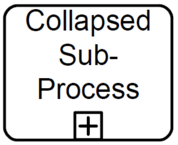 Collapsed
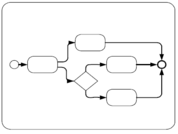 Expanded


Sub-process Rules⌘
- Pools or Lanes can't be used inside a sub-process
- A Sub-process can have only None Start Events
Error creating thumbnail: File missing
- A sequence flow can't cross a sub-process boundary
Sequence Flow⌘

A Sequence Flow is used to show the order that Activities will be performed in a Process.
Token ⌘
- Token traverses the Sequence Flows and passes through the elements in the Process
- A token is a theoretical concept that is used as an aid to define the behavior of a Process that is being performed
- The behavior of Process elements can be defined by describing how they interact with a token as it “traverses” the structure of the Process.
- A token does NOT traverse a Message Flow
Sequence Flow Splitting⌘

- Conditional flow - sequence flow with a condition that is evaluated to determine whether or not the sequence flow will be used
- Default flow - (with slash marker) used only if all the other outgoing conditional flows are not true
Gateways⌘
|
|
|
Gateways are used to control splitting and merging of sequence flows.
|

Exclusive⌘


XOR Gateway
- A diverging Exclusive Gateway (Decision) is used to create alternative paths within a Process flow
- Only one of the paths can be taken, this means the gateway is exclusive
- A Decision can be thought of as a question that is asked at a particular point in the Process
- The question has a defined set of alternative answers
- Each answer is associated with a condition Expression that is associated with a Gateway’s outgoing Sequence Flows
Exclusive Gateway Example⌘

Merging (exclusive)⌘

Parallel Gateway ⌘

AND Gateway
- A Parallel Gateway is used to create or synchronize (combine) parallel flows
- A Parallel Gateway creates parallel paths without checking any conditions; each outgoing Sequence Flow receives a token upon execution of this Gateway
- For incoming flows, the Parallel Gateway will wait for all incoming flows before triggering the flow through its outgoing Sequence Flows
Parallel Gateway Example 1⌘

Parallel Gateway Example 2⌘
Error creating thumbnail: File missing
Quiz, what will happen?⌘

Inclusive Gateway ⌘

OR Gateway
- A diverging Inclusive Gateway (Inclusive Decision) can be used to create alternative but also parallel paths within a Process flow
- Unlike the Exclusive Gateway, all condition Expressions are evaluated
- The true evaluation of one condition Expression does not exclude the evaluation of other condition Expressions
- All Sequence Flows with a true evaluation will be traversed by a token
- Since each path is considered to be independent, all combinations of the paths MAY be taken, from zero to all
- However, it should be designed so that at least one path is taken.
Inclusive Gateway Example 1⌘

Inclusive Gateway Example 2⌘

Event Basics⌘

An Event is something that “happens” during the course of a Process.
- Events affect the flow of the Process and usually have a cause or an impact. The term “event” is general enough to cover many things in a Process.
- The start of an Activity, the end of an Activity, the change of state of a document, a Message that arrives, etc., all could be considered Events
Types of events⌘
- Start Events - indicate where a particular Process will start (generates a token)
- Intermediate Events - indicate where something happens (an Event) somewhere between the start and end of a Process
- Boundary Intermediate Events - attached to the boundary of an Activity
- End Events - indicate where a Process will end (consumes a token - marks the end of a path)
Start and End⌘
- A Start Event is OPTIONAL
- a Process level — a top-level Process or an expanded Sub-Process — MAY have a Start Event:
- If a Process is complex or the starting conditions are not obvious, then it is RECOMMENDED that a Start Event be used
- If there is an End Event, then there MUST be at least one Start Event.
- If there is a Start Event, then there MUST be at least one End Event.
- End events cannot (by definition) accept outgoing sequence flow.
Processes without start or end event⌘
Error creating thumbnail: File missing
- If the Start Event is used, then there MUST NOT be other flow elements that do not have incoming Sequence Flow — all other Flow Objects MUST be a target of at least one Sequence Flow
- If the Start Event is not used, then all Flow Objects that do not have an incoming Sequence Flow (i.e., are not a target of a Sequence Flow) SHALL be instantiated when the Process is instantiated.
- If there is no End Event: every flow object without any outgoing flow means the end of the path
None Events⌘

- None Event does not have a defined trigger or result.
- The Event MUST be displayed without a marker
- None Start Event starts the process and generates new token
- None End Event ends a particular flow and consumes the token
Events Example 1⌘


Events Example 2⌘

No Events Example⌘

Messages⌘

- There are three types of message events
- Start
- Intermediate
- End
- Intermediate event can send or wait for a message (receive a message)
Messages example⌘


Messages and Sequences⌘
- Error creating thumbnail: File missing Sequence Flow
- Solid line with an arrow on one end
- depict when one activity has started and another has ended.
- defines the order in which actives are performed for any given process participant
- Never occurs between participants
- Error creating thumbnail: File missing Message flow
- Defines the flow of information and messages between participants within a process
- Messages NEVER occur within the same participant
- A token does NOT traverse a Message Flow
Sequence and Message flow⌘

Pools and Lanes⌘
Error creating thumbnail: File missing
- Pool = Participant
- The pool shape contains the elements of a process flow performed by the process participant
- The pool shape represents a participant
- The pool shape is optional
Pools and Lanes⌘
- Lane
- A lane in BPMN is an optional subdivision of a pool, but can be used without a pool
- Graphically separates areas of the process diagram for more visibility and understanding
- Documentation only, doesn't execute
- Text can be in any direction
- The meaning of the Lanes is up to the modeler.
- Lanes are often used for such things as internal roles (e.g., Manager, Associate), systems (e.g., an enterprise application), an internal department (e.g., shipping, finance),
Black/White Box Pools⌘

Pool may have no internal details - "black box pool" or may be shown as a "white box pool" with all details.
Event-Based Exclusive Gateway⌘
Error creating thumbnail: File missing
- The Event-Based Gateway represents a branching point in the Process where the alternative paths that follow the Gateway are based on Events that occur
- This is opposed to the evaluation of Expressions using Process data (as with an Exclusive or Inclusive Gateway which are Data Based)
- A specific Event, usually the receipt of a Message, determines the path that will be taken
- Basically, the decision is made by another Participant, based on data that is not visible to Process, thus, requiring the use of the Event-Based Gateway.
Example⌘
- A company is waiting for a response from a customer they will perform one set of Activities if the customer responds “Yes” and another set of Activities if the customer responds “No.”
- The customer’s response determines which path is taken
- The identity of the Message determines which path is taken
- That is, the “Yes” Message and the “No” Message are different Messages
Example⌘
- The receipt of the Message can be modeled with an Intermediate Event with a Message trigger or a Receive Task
- In addition to Messages, other triggers for Intermediate Events can be used, such as Timers
Error creating thumbnail: File missing or Error creating thumbnail: File missing
Artifacts⌘
- Artifacts
- Text annotation
- Groups
- Artifacts have no impact on execution they extend the documentation
- Text objects can be connected to any object with an Association
Group⌘

- Provides a visual mechanism to group elements of a diagram informally.
- Group can be used for documentation or analysis purposes.
- Groups do not affect the flow of the Process.
Text Annotation ⌘
Error creating thumbnail: File missing
- Is a mechanism for a modeler to provide additional information for the reader of a BPMN Diagram
- The Text Annotation object can be connected to a specific object on the Diagram with an Association
- Does not affect the flow of the Process
Association⌘
- Association lines are dotted connections to objects
- Error creating thumbnail: File missingAssociation appears as a dotted line and optional arrow
- A directional Association is often used with Data Objects to show that a Data Object is either an input to or an output from an activity
Data Objects⌘

- The primary construct for modeling data within the Process flow.
- Represented by the rectangle and the folded corner
- Typically attached to activities and flows, but they can be associated with: tasks, gateways, events, sequence lines or message lines
- Data Associations are used to move data between Data Objects.
- Tokens do not flow along a Data Association.
Module 5. Questions⌘
- What types of events are there in BPMN?
- What types of gateways are there in BPMN?
- What is an artifact?
- What is the difference between Pool and Participant?
- What is the difference between Pool and Lane?
Module 6. Business Process Modeling Skills⌘
Advanced Events⌘
Terminate Event⌘

- This type of End indicates that all Activities in the Process should be immediately ended.
- This includes all instances of multi-instances.
- The Process is ended without compensation or event handling.
- Terminate end event in a sub-process ends only that sub-process (without ending parent process).
Timer Events ⌘
- Expresses a time gap in processing or a wait for a period of time.
- Start Timer – start on specific date (Monday at 9am, etc..) or a specific cycle (e.g., every Monday at 9am)
- Intermediate Timer - a specific time-date or a specific cycle (e.g., every Monday at 9am)
- If used in the main flow it acts as a delay mechanism

Timer Start Event⌘

- Starts the Process on specific date (Monday at 9am, etc..) or a specific cycle (e.g., every Monday at 9am)
Timer Example 1⌘

Intermediate Boundary Events⌘

The process waits for a certain action to happen
- Can be attached to the boundary of an activity
- Message (arrives from a participant and triggers the Event)
- Timer (absolute date or cycle – e.g. Every Monday at 9 am) which tigers the event
- Error (only boundary of the activity)
- Signal (send to everyone)
Timer Example 2⌘

Interrupting vs. Non-Interrupting⌘

Signal Events⌘
- A Signal is for general communication within and across Process levels, across Pools, and between Business Process Diagrams.
- A BPMN Signal is similar to a signal flare that shot into the sky for anyone who might be interested to notice and then react. Thus, there is a source of the Signal, but no specific intended target.

Signal Event Example 1⌘

Signal Event Example 2⌘

Conditional Events ⌘
- Is triggered when a condition such as "Temperature above 20°C" become true.


Link Events⌘
- A Link is a mechanism for connecting two sections of a Process.
- Link Events can be used to avoid long Sequence Flow lines.
- The use of Link Events is limited to a single Process level (i.e., they cannot link a parent Process with a Sub-Process or one pool to another pool).
- There can be multiple source Link Events, but there can only be one target Link Event.
- Link event must have name

Link Events Example⌘

Link Events as Off-Page Connector⌘

Error Events⌘

- An Error is generated when there is a critical problem in the processing of an Activity or when the execution of an Operation failed
- An Error indicates that a named Error should be generated.
- 3 types of error events:
- Start Event Sub-Process Interrupting
- Intermediate Boundary Interrupting
- End
- Process can't wait for an error or rise an error in itermediate event (only in Boundary Intermediate)
- Process can't be instantiated using error event (only in Event Sub-Process)
Error Events Example 1⌘


Error Events Example 2⌘

Error Events Example 3⌘

Escalation Events⌘

- An Escalation identifies a business situation that a Process might need to react to.
- In contrast to an Error, an Escalation by default is assumed to not abort the Activity to which the boundary Event is attached.
Escalation Example⌘

Task and Subprocesses⌘
- Task
- A rounded rectangle (AKA roundtangle) showing the finest or atomic process step. It cannot be broken down to a finer level.
- Subprocess (collapsed)
- A roundtangle that can contain a series of other steps
- Subprocess (expanded)
- Shows all the subprocess activities
- May contain "-" sign
Subprocesses⌘
Error creating thumbnail: File missing
- A Sub-process is a compound activity in that it has detail that is defined as a flow of other activities
- Expanded sub-process may be used as a mechanism for showing a group of parallel activities in more compact way
- Expanded sub-process does not need to include Start Event or an End Event and the sequence flow to/from these Events
Subprocess Markers⌘
Error creating thumbnail: File missing
Ad-Hoc⌘

- Ad-Hoc Sub-Process contains a number of embedded inner activities and is intended to be executed with a more flexible ordering compared to the typical routing of processes
- It is possible to specify sequence flows between some of the contained activities.
Compensation⌘

- Compensation is concerned with undoing steps that were already successfully completed, because their results and possibly side effects are no longer desired and need to be reversed.
- If an Activity is still active, it cannot be compensated, but rather needs to be canceled.
- Compensation is performed by a compensation handler. A compensation handler performs the steps necessary to reverse the effects of an Activity.
Types of Tasks ⌘

Receive Task ⌘
Error creating thumbnail: File missing
- Waits for a Message to arrive from an external Participant
- Once the Message has been received, the Task is completed
Error creating thumbnail: File missing
- Starts the process
- MUST NOT have any incoming Sequence Flow
- Instantiate attribute MUST be set to true
Send Task ⌘
Error creating thumbnail: File missing
- Sends a Message to an external Participant.
- Once the Message has been sent, the Task is completed.
Service Task ⌘
Error creating thumbnail: File missing
- uses some sort of service, which could be a Web service or an automated application.
User Task ⌘

- A typical “workflow” Task where a human performer performs the Task with the assistance of a software application
- Examples:
- Phone operator updates customer record
- User changes his password
Manual Task ⌘
Error creating thumbnail: File missing
- Is expected to be performed without the aid of any business process execution engine or any application
- Example:
- A telephone technician installing a telephone at a customer location
Business Rule Task ⌘
Error creating thumbnail: File missing
- Provides a mechanism for the Process to provide input to a Business Rules Engine and to get the output of calculations that the Business Rules Engine might provide
Script Task ⌘
Error creating thumbnail: File missing
- Is executed by a business process engine
- The modeler or implementer defines a script in a language that the engine can interpret
- When the Task is ready to start, the engine will execute the script
- When the script is completed, the Task will also be completed.
Loops and multi-instance⌘
Standard Loop ⌘

- The Activity will loop as long as the boolean loopCondition is true
- The condition is evaluated for every loop iteration, and MAY be evaluated at the beginning or at the end of the iteration (testBefore = true lub testBefore = false)
- In addition, a numeric cap can be optionally specified - loopMaximum
- Loop activity instances are sequentially executed - one after another.
- Loop Activity is similar to DO WHILE loop.
Multi-Instance Activity⌘
Error creating thumbnail: File missing Error creating thumbnail: File missing Multi-Instance parallel
Error creating thumbnail: File missing Error creating thumbnail: File missing Multi-Instance sequential
- The instances MAY execute in parallel or MAY be sequential.
- Multi-Instance Activites are used with collection of items
- Multi-Instance Activity is similar to FOR EACH loop
Multi-Instance Activity Example⌘
Error creating thumbnail: File missing
Module 6. Questions⌘
- What Types of Tasks are there in BPMN?
- What is the difference between Interrupting and Non-Interrupting event?
- What is the difference between Escalation and Error event?
- What is Link Event?
- What is Conditional Event?
- What is the difference between Signal and Message Event?
Module 7. Process Quality, Governance,
and Metrics Frameworks⌘
Source of information⌘
- APQC Process Classification Framework, V 6.0.0
- Supply Chain Council's Supply-Chain Operations Reference model (SCOR), v10.0
- Introduction to the Value Reference Model (VRM)
- Business Process Maturity Model Specification, V1.0
- Six Sigma for Dummies, Second Ed. (2012)
Today's Business Environment⌘
- Many different rules and regulation
- SOX, BASEL, ...
- Many different frameworks for achieving compliance or improving maturity in an area
- BPM is part of the solution
APQC⌘

- The American Productivity & Quality Centre
- Non-profit, internationally recognized resource for process and performance improvement
- Helps organizations adapt to rapidly changing environment, build new and better ways to work and succeed in a competitive marketplace
- The APQC Process Classification Framework (PCF) serves as a high-level, industry-neutral enterprise model that allows organizations to see their activities from a cross industry process viewpoint.
- The PCF organizes operating and management process into 12 enterprise level categories, including process groups and over 1000 processes and associated activities
APQC PCF⌘

PCF Levels⌘

PCF Example⌘

SCC and SCOR⌘

- Supply-Chain Council (SCC) is a global non-profit consortium whose methodology, diagnostic and benchmarking tools help organizations make dramatic and rapid improvements in supply chain processes.
- The framework – the SCOR process reference model – lets companies quickly determine and compare the performance of supply chain and related operations within their company or against other companies.
SCOR⌘
- The Supply-Chain Operations Reference (SCOR) is the product of the Supply-Chain Council
- The SCOR model captures the council's consensus view of supply chain management.
- SCOR is a unique framework that links business process, metrics, best practices and technology features into a unified structure to support communication among supply chain partners and to improve the effectiveness of supply chain management and related supply chain improvement activities
SCOR PRM⌘
A Process Reference Model Contains:
- Standard descriptions of management processes
- A framework of relationships among the standards processes
- Standard metrics to measure process performance
- Management practices that produce best-in-class performance
- Standard alignment to features and functionality
SCOR Scope⌘

SCOR Is Based on Five Level 1 Management Processes
- Plan, Source, Make, Deliver, and Return
Value Chain Group⌘

- The VCG Business Process Transformation Framework provides robust reference dictionaries and methods that are tested and proven for the extended enterprise value network
- The standard framework promotes consensus and helps drive continuous improvement and transformation of process
Value Reference Model⌘

The structure of the VRM (Value Reference Model) supports and enables corporations to integrate their three critical domains;
- Global Product Developments,
- Global Supply Network Integration
- Global Customer Success
using one reference model to support the vision of an integrated value chain.
VRM⌘

- Key elements of the standard process VRM dictionary include inputs/outputs, metrics and best practices
- Three levels of processes: Strategic, Tactical and Operational
- At the each level the processes are categorized as plan, govern and execute
Business Process Maturity⌘
- Frameworks and best practices will not be implementable without a process!
- In the 1980s, Watts Humphrey, working at IBM, explored how to best introduce quality practices into software organizations.
- BPMM describes Business Process Maturity levels
BPMM Maturity Levels (OMG)⌘
- Level 1: Initial
- Inconsistent, ad hoc business processes
- results that are difficult to predict.
- Level 2: Managed
- work within local work units is performed in a repeatable way
- work units performing similar tasks may use different procedures
- Level 3: Standardized
- common, standard processes are synthesized from best practices identified in the work groups and tailoring guidelines are provided for supporting different business needs
- Standard processes provide an economy of scale and a foundation for learning from common measures and experience
BPMM Maturity Levels (OMG)⌘
- Level 4: Predictable
- the capabilities enabled by standard processes are exploited and provided back into the work units
- Process performance is managed statistically throughout the workflow to understand and control variation so that process outcomes can be predicted from intermediate states
- Level 5: Innovating
- both proactive and opportunistic improvement actions seek innovations that can close gaps between the organization’s current capability and the capability required to achieve its business objectives.
OMG BPMM⌘

Six Sigma⌘

- Six Sigma seeks to identify and remove the causes of defects and errors in manufacturing and business processes
- Sigma is used to represent the standard deviation (a measure of variation) of a statistical population.
- The name Six Sigma comes from the notion that if one has six standard deviations between the mean of a process and the nearest specification limit, there will be practically no items that fail to meet the specifications
- The widely accepted definition of a six sigma process is one that produces 3.4 defective parts per million opportunities (DPMO)
Six Sigma Methods ⌘
- DMAIC
- used for EXISTING PROCESSES
- Define, Measure, Analyze,
- Improve, Control
- DMADV
- Used for NEW PROCESSES
- Define, Measure, Analyze,
- Design details, Verify the design
Cause of Variation⌘
- Six Sigma often uses a top control chart to determine whether a manufacturing or business process is in a state of statistical control or not
- Common Cause of Variation
- usual, historical, quantifiable variation in a system
- Also known as a Type I error
- Special Cause of Variation
- unusual, not previously observed, non-quantifiable variation
- Also known as a Type II error
Control Chart⌘
Error creating thumbnail: File missing
Control Chart⌘

Quality According to ISO 9000:2000⌘
- Quality is defined as: “the degree to which a set of inherent characteristics fulfils requirements”
- Quality is the degree to which the material meets the specification (expected metrics)
ISO9000⌘

- ISO stands for International Organization for Standardization (fr. Organisation Internationale de Normalisation)
- ISO 9000 is a family of standards for quality management systems
- ISO standards are maintained by ISO and is administered by accreditation and certification bodies.
ISO9000⌘
- An organization that has been independently audited and certified to be in conformance with ISO 9001 may publicly state that it is "ISO 9001 certified" or "ISO 9001 registered"
- Certification to an ISO 9000 standard does not guarantee the compliance (and therefore the quality) of end products and services
- It certifies that consistent business processes are being applied.
Other Process Frameworks⌘
- Just in time (JIT) is an inventory strategy implemented to improve the return on investment of a business by reducing in-process inventory and its associated carrying costs.
- JIT emphasizes inventory as one of the seven wastes (overproduction, waiting time, transportation, inventory, processing, motion and product defect), and as such its practice involves the philosophical aim of reducing input buffer inventory to zero.
Run Charts⌘

- Displays observed data in a time sequence
- Represents some aspect of the out or performance of a manufacturing or other business process
- Run charts are analyzed to find anomalies in data that suggest shifts in a process over time or special factors that may be influencing the variability of a process
Heat Maps⌘
Error creating thumbnail: File missing
- A heat map is a graphical colour display of data
- Heat maps are also used in places where the data is volatile and representation of this data as a heat map improves usability
- There are also heat maps for showing the housing price in various regions
Risk Management⌘
|
|
|
Regulatory Process Drivers⌘
- COBIT
- BASEL II
- SOX
- Corporate Governance & Compliance
- Authoritative Rules
- Safe Harbour
- Balanced Score Card
COBIT⌘
- The Control Objectives for Information and related Technology (COBIT) is a set of best practices (framework) for information technology (IT) management
- Created by the Information System Audit and Control Association (ISACA) and the IT Governance Institute (ITGI) in 1992.
- COBIT provides managers, auditors and IT users with a set of generally accepted measures, indicators, processes and best practices to assist them in maximizing the benefits derived through the use of information technology and developing appropriate IT governance and control in a company
Corporate Governance⌘
- Corporate governance refers to the mechanisms, processes and relations by which corporations are controlled and directed.
- Governance identify the distribution of rights and responsibilities among different participants in the corporation (such as the board of directors, managers, shareholders, creditors, auditors, regulators, and other stakeholders) and includes the rules and procedures for making decisions in company.
Corporate Governance - Why do we need it?⌘
- The shareholder delegates decision rights to the manager to act in the principal's best interests.
- This separation of ownership from control implies a loss of effective control by shareholders over managerial decisions.
- A board of directors often plays a key role in corporate governance. It is their responsibility to endorse the organization's strategy, develop directional policy, appoint, supervise and remunerate senior executives and to ensure accountability of the organization to its owners and authorities.
BASELII⌘
- Issued by the Basel Committee on Banking Supervision
- Recommendations on banking laws and regulations
- International standard that regulates how much capital banks need to put aside to guard against the types of financial and operational risks banks face
- Tries to protect the international financial system from the types of problems that might arise if a major bank or a serious of banks collapse.
SOX⌘
- The Sarbanes-Oxley Act of 2002
- AKA the Public Company Accounting Reform and Investor Protection Act of 2002
- US federal law enacted in response to a number of major corporate and accounting scandals (Enron)
- Contains 11 titles that describe specific mandates and requirements for financial reporting (from additional corporate board responsibilities to criminal penalties)
Compliance⌘
- Compliance is ensuring that the requirements of law, regulations, industry codes, organizational doctrines and contractual arrangements are met.
- Authoritative rules to which we comply with must not be of own creation
- Collectively, we refer to these as authority documents
Authority Documents⌘
- Standards are created by well organized groups or are generally accepted within the industry
- Regulations are rules of law that,
- if not followed, can result in penalties.
- State that something must be done
- Promulgated by governmental agencies to interpret or expand the reach of statuses
- Guidelines are detailed outlines and plans for determining a course of action
- Best practices are programs, initiatives or activities which are considered leading edge or exceptional models for other to follow
Safe Harbour⌘
- In a law or regulation is a short-cut used by the regulators to make it easier for people to determine whether they are in compliance with the law without requiring an in-depth analysis of each particular case.
- Provides that if you take the actions required to be within the safe harbour, you will automatically be considered to be in compliance with that particular aspect of the law or regulation
Balanced Score Card⌘

Balanced Score Card⌘
- Translates an organizations mission and strategy into a comprehensive set of performance measures that provides the framework for a strategic measurement and management system
- Measures organization performance across four balanced perspectives: financial, customers, internal business process and learning and growth
- BSC is a management framework that provides managers with financial instrumentation to navigate into future competitive success
- An accurate understanding of their goals and the methods for attaining those goals is vital
Key Performance Indicator⌘
- KPIs are financial or non-financial metrics that combine with CSF (Critical Success Factors) used to help an organization define and measure progress toward organizational goals
- KPIs can measure, predict and manage the business health of a company in real time, KPIs are dynamic real-time enterprise metrics
- A CSF is some feature of the internal or external environment of an organization that has a major influence on achieving the organization's aims.
- A KPI is a quantifiable criteria that an organization uses to measure its performance in terms of meeting its CSFs.
- Examples
- CSF = Installation of a call centre for providing superior customer service (and indirectly, influencing acquiring new customers through customer satisfaction).
- KPI = Number of new customers. (Measurable, quantifiable) + Threshold = 10 per week [KPI reached if 10 or more new customers, failed if <10]
Module 7. Questions⌘
What is:
- APQC PCF
- COBIT
- BASEL II
- SOX
- Safe Harbour
- Balanced Score Card
- Risk
- Heat Map
- Run chart
Appendix
BMM Overview, Figure 7.1 - OMG Business Motivation Model v1.1 Spec, page 12

Business Process Model and Notation, v2.0, page 261


